
Should Billy Idol Be Dead?
Film Review of 'Billy Idol Should Be Dead' - Streaming on Hulu

The timing for the new documentary, Billy Idol Should Be Dead, directed by Jonas Åkerlund and currently streaming on Hulu, couldn’t be better. With yesterday’s fresh news that the Rock & Roll Hall of Fame is finally inducting Billy into the Class of 2026, the film serves as a raw and exhaustive exploration of the man behind the snarl. Åkerlund is perfect for this reveal; a former Swedish metal drummer turned director for legends like Madonna and Metallica, he understands the inner mechanics of rock stardom. He tracks the transformation of a middle-class London kid named William Broad into one of the most recognizable icons of the MTV era, navigating the highs of global superstardom and the lows of a life nearly lost to addiction.
Watching it was a surreal memory, a sort of high-end scrapbook of a world some of which I once inhabited. Åkerlund’s aesthetic—the black-and-white talking heads and those frantic animated transitions—felt like a stylized bridge between the rock star parody the world knows, the persona, and a form of the person I actually met during my years in the music industry. From my days at 91X radio in San Diego in the 80s, where Billy was an irreverent king of our “alternative” playlist, to the late nights in the 90s, the film finally shows the world what those of us in the industry already knew: Billy Idol was a risky, transformative “job” created by a clever university dropout named William Broad.
It turns out the rebellious snarl was part sales tactic inherited from his salesman father—a drive to prove he could do something extraordinary and escape the gravity of a middle-class life. Born in Stanmore, Middlesex—a leafy suburb on the northwestern edge of London—he was a normie kid with a nurse mom who spent a brief, formative jaunt on Long Island as a child before the family moved back to the UK. For a kid like William Broad, a “leafy suburb” probably represented the very thing punk was trying to tear down: the safety, predictability, and polite, middle-class “niceness” that felt suffocating compared to the raw energy of the London underground.
It was that return to the London suburbs that dropped him into a burgeoning punk scene that numbered only in the hundreds. While the construction of the persona eventually became fueled by drugs and a sense of calculated chaos, the film suggests it started as an unwittingly natural progression. It was about proximity to a scene and the luck of timing and lighting. He landed a guitarist gig in a band, which led to meeting bass player Tony James, and that proximity to the core of the original punk movement led him to front Generation X. Tony James offers a poignant reflection on those early days and the metamorphosis he witnessed:
“We were just two kids who found each other in the middle of a whirlwind. Watching him become Billy Idol was like watching a friend disappear into a flame—he wanted it so badly that he was willing to burn everything else away to get there. It was thrilling, but it was also the beginning of a long goodbye to the boy I first met.”
Because he wasn’t “working class”—the essential DNA of British punk rebellion against the government at the time—the hardcore scene often rejected him as a fake. Steve Jones of the Sex Pistols, who was at the very core of that original movement, captures the friction of that time, noting:
“Billy was always a bit different from the rest of us lot. He had that look, and he knew how to use it, but there were plenty who thought he was just playing a part. He wasn’t from the gutter, and in the beginning, that was a crime in the punk scene.”
By the time he accidentally connected with producer Keith Forsey to bridge those worlds of punk and dance with Dancing with Myself, he had dominated Generation X so completely that he was the only one left. His timing was impeccable; as MTV launched in 1981, Billy’s visual flair and cinematic videos became the engine for his global iconic stardom. Videos like White Wedding showcased exactly how he understood the power of the image, blending punk aggression with a high-gloss, stylized aesthetic that the new medium couldn’t get enough of. John Sykes, one of the founders of MTV, explains why Billy was the perfect face for the new medium:
“Billy Idol was the first artist who truly understood the power of the frame. He wasn’t just performing a song; he was selling an attitude that jumped off the screen. He was the visual architect of the MTV era, and without him, the channel might have looked very different in those early years.”
As the persona began to take shape, William Broad had the sharp sense to recognize that this character was exactly what the public craved. He began to fuel that image with booze, sex, and hard drugs to close the gap between his quiet, literate self and the manic rock star the audience expected.
To manage the massive expansion that followed, Billy was guided by a succession of legendary managers who had built some of the biggest icons in history. First was Bill Aucoin, the man who popularized KISS, who, ironically, eventually died from his own struggles with drugs. It was through Aucoin that Billy found his musical soulmate and the engine for the Rebel Yell era. Aucoin had been managing a New York band called the Fine Malibus and realized their guitarist, Steve Stevens, extended Idol’s punk sensibilities. Stevens became the guitar-playing virtuoso partner who would define the Billy Idol sound for decades, proving that the chemistry was more than just a label pairing.
Brendan Bourke, his longtime point person at Chrysalis Records, was there to witness that transition into the American market, noting the duality of the man:
“When Billy arrived in New York, we weren’t just selling a singer; we were selling a revolution that you could dance to. He had this incredible ability to look into a lens and make every kid watching feel like they were in on a secret that their parents would never understand. But the secret was that underneath the spikey hair and the leather, he was the hardest-working person in the building—he just made it look like a riot.”
However, once he made the jump to New York and global stardom hit, the “Billy Idol” creation became a beast in its own right. The pressure to maintain that persona—to be something beyond just an artist making music—pushed the drugs and the chaos out of his control. He was followed by Freddy DeMann, who was simultaneously catapulting Madonna to the top of the world. Finally, he found fellow Brit Tony Dimitrades, who managed him for decades and whom I knew well at the time. Now retired, Tony D appears in the film without speaking lines, while Freddy DeMann offers a biting perspective on the chaos of managing a superstar who was effectively a functioning disaster:
“The drugs weren’t just a part of the scene; for Billy, they became the fuel for the mask. It got to a point where you weren’t sure if you were talking to the artist or the addiction, but the bills still had to be paid, and the videos still had to be made.”
The film highlights the high cost of maintaining that “product.” A key figure introduced is “Art,” whom Billy’s longtime girlfriend and baby mama, Perri Lister, describes as a roadie, but was more of an addiction accomplice. I remember seeing Art all over the LA scene in the early 90s, sometimes with Billy and sometimes without. The film is direct about the reality: Art was both caretaker and supplier, a shadow figure in the chaos who once famously noted their dynamic:
“I wasn’t just there to move the gear; I was there to keep the engine running, whatever that took. Sometimes that meant being the only one who knew where he was or what he needed to stay ‘Billy’ for the next show.”
By the time he reached Los Angeles, the wheels were coming off. Offstage, the beast was worsening, and it was becoming increasingly noticeable to those in his orbit; the line between performance and reality was dissolving. Their trip to Thailand was the first major unraveling—a descent into heroin and trouble that marked the beginning of his addiction’s toll. The second blow was the 1990 motorcycle crash in LA that almost took his leg. There is a poignant circularity in seeing his parents, the very people he tried to outrun, being the ones to nurse him through that recuperation.
The film suggests a third “unraveling” that served as his ultimate saving grace: the arrival of his children, Willem Wolf Broad and Bonnie Blue Broad; the later discovery of his “DNA” son, Brant, born before he was even Billy Idol; and the responsibility of fatherhood. Those events seemingly woke him up; otherwise, he might be dead. Today, his three children and several grandchildren seem to be a primary source of solace, providing a grounded reality that the “Billy Idol” persona never could.
The on-screen industry players made the experience deeply personal for me. Seeing my old friend and former music TV show producer boss, John Diaz—who is one of William’s long-standing close friends, though in those years it was hard to know for sure whether he was friends with Billy or William—and Tony Dimitrades felt like a reunion. Every time we crossed paths, he was fully styled and dressed as “Billy,” yet the humanity would peek through the costume.
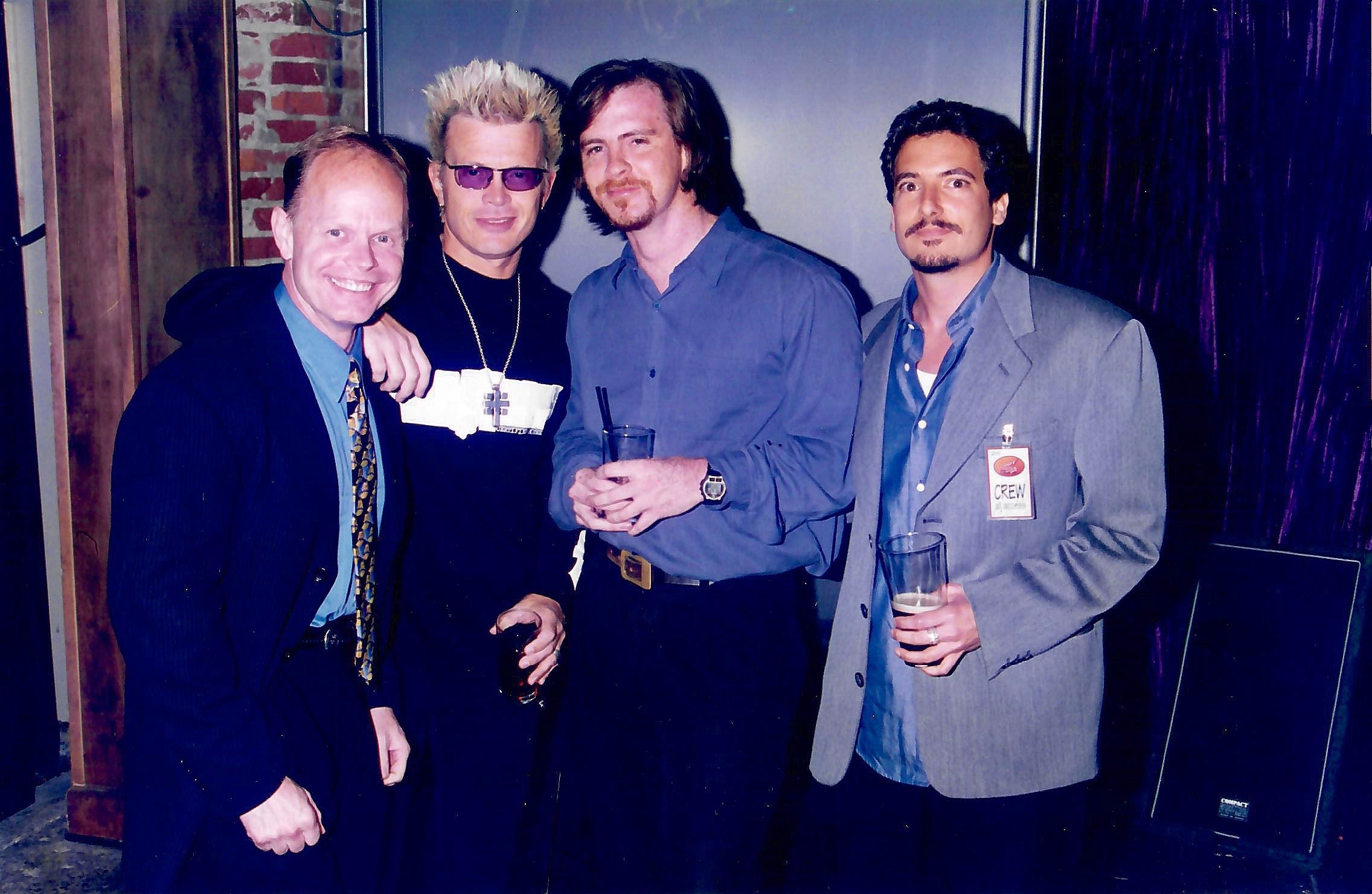
In the late 90s, while co-producing a music concert TV show with Diaz from 1996 to 1999, I remember a phone conversation with William; I was contemplating Lasik surgery and knew he’d had it done. He spent the time giving me his honest, kind opinion—a normal guy talking shop about eye doctors. It was a jarring contrast to the night at a small Santa Monica bar with Diaz, where I was the drunk one, spilling a full pint of beer onto his leather pants—whoops. Or that New Year’s Eve in Aspen in the early 90s, around 1991, where I found myself in the front seat of a Jeep Cherokee while Billy, lit after his China Club live performance, was laid out in the back like cargo on our way to yet another after party.
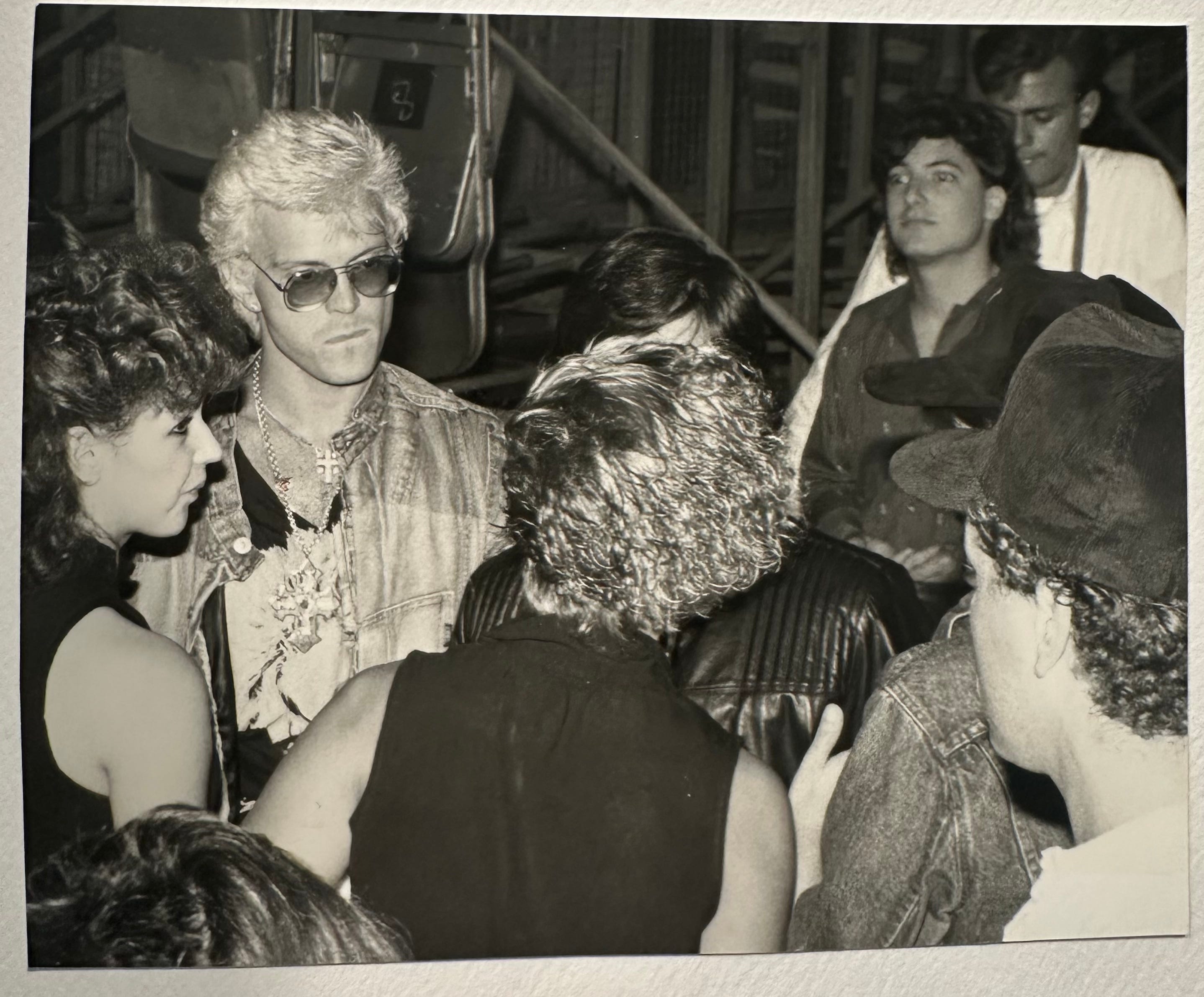
Even back in those 80s days at the San Diego Sports Arena, when I first met him backstage, he had the hair and the gear, but he was wearing his thick eyeglasses. It was a reminder that the persona was a choice, but the man was still there. Diaz nails the feeling of being in that orbit:
“With Billy, there was no halfway. Whether we were on tour or just navigating the scene, you were always aware that you were standing next to a lightning rod. My job wasn’t just to capture the performance; it was often just making sure the lightning didn’t strike the same place twice.”
Duff McKagan of Guns N’ Roses underscores just how influential that lightning rod became for the generation that followed, stating:
“For us, Billy was the template. He had the punk foundation, but he understood the theater of it all. We looked at what he was doing and saw the blueprint for how to be a rock star in a world that was changing.”
Every run like that has its ceiling, and the film addresses the moment the momentum stalled with the 1993 release of Cyberpunk. Billy was incredibly prescient, exploring home-studio digital recording, the internet, and the virtual reality age before any of them were mainstream enough to truly matter. He chalks the misstep up to being ahead of his time, and while critics might argue the music simply didn’t hit the mark, it signaled the end of his era as a dominant force of new releases. Patrick Stump, singer of Fall Out Boy, who also scored the film, notes the brave, if misunderstood, nature of that pivot:
“You have to respect an artist who is willing to blow up their own successful formula to chase where the world is going. Cyberpunk was a risk that showed Billy was more than just a snarl; he was looking at the future, even if the world wasn’t ready to see it through his eyes yet.”
The documentary captures the sheer scale of his peak, including the after-parties like the one I attended at the Hollywood Tropicana following an LA Forum arena show. Seeing the “Weez,” Pauly Shore, reporting there for MTV, brought back the grit of that era—the mud wrestling and the eccentric mix of rock and roll debauchery.
If there is a film criticism to be made, it’s that I would have liked to see and hear more about his current touring and career—a deeper look into where he is going in the future rather than just where he’s been. But what makes this film so interesting, and why it’s a must-watch for any fan or music lover, is the reveal that most people wouldn’t imagine. People see what is presented to them—the leather, the bleached blonde spiked hair, the stage antics, and the irreverent snarl. But the true beauty of watching this is seeing William Broad revealed beneath it all.
Billy Idol Should Be Dead exposes the quiet, literate, calculating man. It’s a reminder that behind the global hits and the “salesmanship” was a real person trying to survive his own creation. He invented himself, maybe to prove his worth to a disappointed father or to himself, but it took those three unravelings and the eventual peace of family life to finally let the real person outlive the rock star parody. Ultimately, it hits home to see that he isn’t dead—that he is here, able to take us back and show us exactly who he was and who he has become. After all the leather, the heroin, and the Jeep Cherokee rides, he has survived the flames to tell the story of how he got here. He didn’t just survive; he actually grew up. He is a man, finally, and fortunately, undead. As Billy himself reflects in the film:
“Luck is one thing, but it’s what you do with the luck when it shows up—you have to be ready to grab it and ride it until the wheels come off, even if you’re the one who loosened the bolts in the first place.”
Thank you for that brilliant review! I need to see this!